
29/04/2017
Speaking in public – some notes
A few months ago, as part of the job I was doing then, I attended a lunch about the practices behind corporate coaching, i.e. training CEOs and the like of big companies how to talk in public.
Co-incidentally I was talking with a friend in Madrid later that day, and she had been accepted to talk at her local TEDx event. The talk I attended drew many parallels between TED talks and the needs of a corporate presentation.
Below is a summary of some of the notes that I took at the talk and then sent to my friend.
It is important to get the opening right. The entire audience will only give you 100% of their attention for the first twenty seconds. you need to be impressive in those twenty seconds. Leave the housekeeping, like who you are etc for later in the talk.
There are six ways to start a good talk.
- Set a Challenge
- Ask a Question
- Tell a Story
- Surprise Them
- Share a problem
- Show empathy
The following TED talks demonstrates each of these points in their first 20 seconds.
Set a Challenge – How to make hard choices
Ask a Question – How giant websites design for you and a billion others too
Tell a Story – The state of the climate and what we might do about it
Surprise Them – What animal madness means for us humans
Share a problem – Why we have too few women leaders
Show empathy – How to live before you die
The other key point is the End. We remember the last think you say best.
Talks are best illustrated by stories. Facts are boring, stories engage. An example of this is adverts for charities. Which engages more? The one with the fact of how many people are starving or one telling the story of one starving child name Sarah.
Stores have three parts.
- Start – with the proposition
- Middle – the stories is expanded, often rising and falling
- End – summing up of the moral – often more than once.
Use the Intent, Message, Evidence, Audience method to write your story.
Intent – Why? Why are you telling the story?
Message – The idea the audience must know when they leave the room. This idea should be able to be summed up in a tweet, i.e. 140 characters.
Evidence – bring you point to life. Fact inform, stories will be remembered. Remember Facts, Observations, Anecdotes, Metaphors. The further along these four, the more engaging the device.
Audience – Ask "so what?" Think about the audience as an intelligent 16 year old.
Other points include:
- Use your voice to add meaning.
- Slowing down acts like a verbal highlighter.
- Silence signals something important is coming.
- Presentation speech rate should be around a third slower than conversational speech (around 140 words per minute). This comes from breaking information up and using short sentences.
- Varying pitch is conversational style and more interesting to listen to.
- our body language is important too.
30/03/2017
Lost in Life?
Don’t know what you want to be when you grow up. Don’t worry, many successful people never knew the answer either…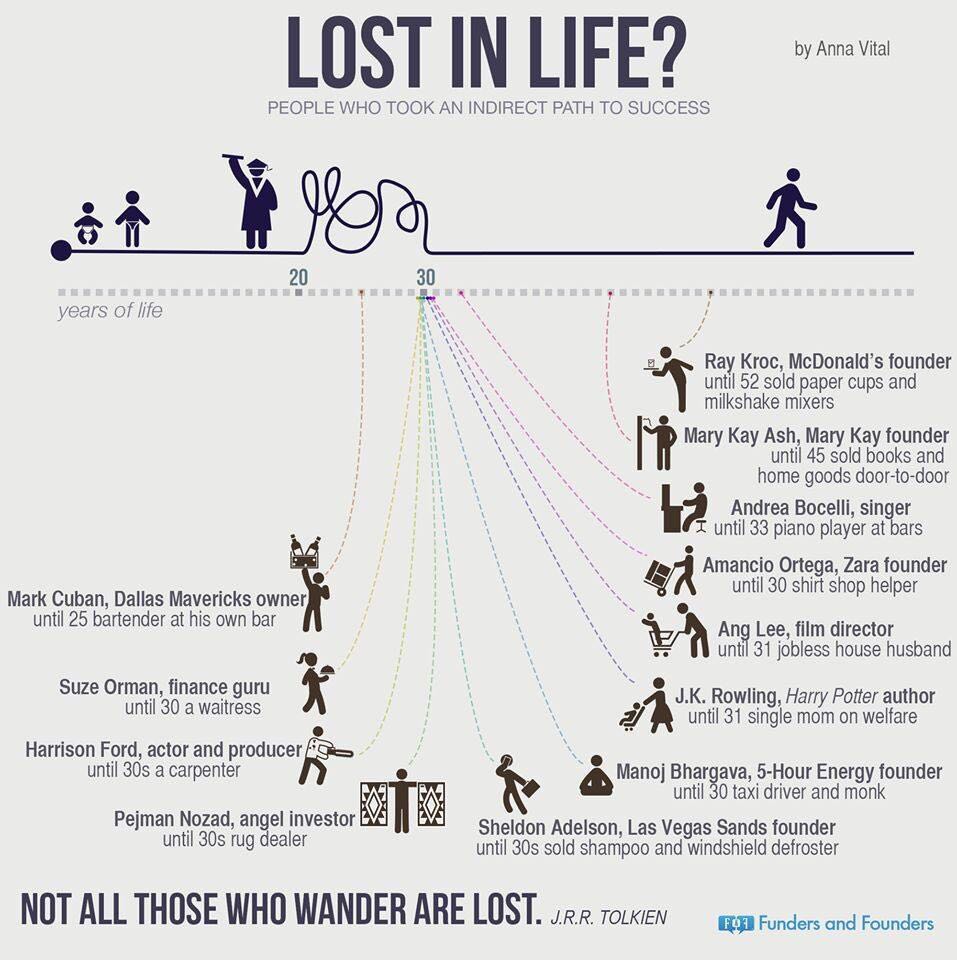
30/03/2017
In memory of Hans Rosling
I posted this on my Facebook at the beginning of February, but I thought it deserved to go on this blog as well…
"When I grow up I want to be Hans Rosling". Today I learnt the great man has died. His was the first TED talk that I ever saw. Every one of his talks are my favourite TED talks. He is the reason that in the last 15 months I’ve attended 7 TED events. I even referenced him in my Masters report. RIP Hans Rosling. You were great.
Hans Rosling TED playlist
14/04/2017
Living My Legend in Stuttgart, part 2
I gave a presentation at Live Your Legend Local Stuttgart about my journey with Live Your Legend. Much of what I talked about I have previously written about on this blog.
My presentation was recorded. I have taken this footage and edited it down into an online with presentation with slides and a transcript. You can also view the slides here.
Minutes before I gave this talk I had just received news that I had got a new job. One that I really wanted. Consequently I was very excited while giving the talk.
The presentation was given in the corner of a noisy cafe. So the sound is not great and the video quality itself is not great because of the lighting. But I think you are able to understand everything that is being said, despite me tripping over my words.
26/03/2017
Living My Legend in Stuttgart
I started this blog in November 2015 as part of following the Live Your Legend (LYL) website. Throughout the following twelve months I had a lot of time and I tried to follow everything LYL suggested. My take on their philosophy was that you won’t know what you are truly meant to do in your career until you truly know yourself.In that year I followed up on each of their blog posts, I did two of their courses, I went to other events, meetings, groups and courses. Trying lots of new stuff.
Then in November 2016 I got a new job. Not the job that LYL was leading to. But a full-time job that paid money. I needed it. From then on I did not follow every thing LYL posted about. I think a lot of it started to become repetitive anyway. But they had set my course in motion towards “living my legend”. I continued with all the new stuff I had been doing. I think, whether consciously or sub-consciously, I was continuing my self discovery.
One of the LYL courses that I did was “Connect With Anyone” (CWA). As part of this course I was put in a mastermind group which was given the name Cepheus. After CWA had finished, Cepheus remained a cohesive group. With members in London, Germany, Madrid and Denmark, we meet every week via Skype for an hour. I have found this group invaluable in helping me maintain the momentum of moving to something new and better in my life. LYL talks about having an accountability buddy to help you keep to your plan. Cepheus has become my accountability buddy.
Recently, because of LYL and Cepheus, two significant things have happened to me. Almost simultaneously.
As I had been at my new job for some months, I had to take some annual leave. I decided to visit one of the members of Cepheus – Annie in Stuttgart. As she was a member of her LYL Local group, I wanted to visit them then.
This snowballed, from just a visit, to me giving a presentation at their meeting. Also two other Cepheus members, Jonas and Miriam, visited from other parts of Germany. The meeting with LYL Stuttgart and with other Cepheus members all went really well. It was an incredible weekend. Much better than I could have imagined.
The presentation that I gave was about my journey with LYL so far. I gave a Keynote presentation and much of it was taken from this blog. At the end of the presentation I was able to report of some really good news. Which is the second of the significant things.
I got my current job back in November 2016. It was more or less the same kind of job that I had previously had. Not the great change that I wanted from doing LYL. However I had not had much employment in the year before this and I needed a job. And it was a job I could do well.
But as I had been following LYL, I had reframed my CV, my LinkedIn profile, the things that I was saying to employment agencies and, I think, my mindset. I had been pursuing the work I really wanted to do. Admittedly when I got my current job, I seem to stop. But, in the background of my life, the momentum was still there.
In late January an employment agent approached me with a new job. I thought there was no harm in looking and it turned out to be a very good fit for me, both in terms of the skills and experience that I had, but also in the direction that I really wanted to take my career. The application process when on for weeks and weeks.
Then literally ten minutes before the LYL Stuttgart event I got a call from this new employer saying that I had got the job. My final slide in my presentation at the event was asking the question, does LYL work. I think this news of my new job proves that it does.

