
14/05/2016
The London Business Show
I went to The Business Show at London’s ExCel convention centre on May 11 and 12.
I’m not sure that I want to start my own business. I went to this show to see what it was about, to think about my options and to “dip my toe in the water”. Besides it had loads of free talks and there's nothing wrong with listening.
Out of the many talks I attended, there were two from which I gained useful information.
John Davy, Make your LinkedIn profile work for you
This talk was standing room only and the best talk I saw all show. Full of information and very little selling.
I think I was already doing a lot of what he advised on LinkedIn, but since his talk I have already changed some things and I will continue to refine it.
Your LinkedIn page should clearly tell:
- who you are
- what you do
- why you do it
Get found – What problem do I solve, from the perspective of the customer?
Get viewed – stand out.
Get results – have a call to action: “call me" or link to website.
Your professional headline should be full of keywords and not just a job description. In fact, probably not a job description, but something that differentiates you from others. This way you will turn up in a LinkedIn search.
Link various parts of LinkedIn profile to various sections of your website.
The only "have to have" sections on a LinkedIn profile are:
- Summary
- Experience
- Education
- Advice for contacting
- Skills
- Connections
- Rich Media
Andy Harrington, Passion into profit
This guy is professional speaker. A little guy with loads of presence. This talk followed the previous in the same theatre. He certainly got the audience more engaged and awake. I think of all the 'energetic' speakers I saw, this guy got the tone most right.
He piqued my interest because he was about igniting passion. This is one of the things I'd like to do. I once had passion for business, I which I had it again.
My notes of his talk:
- Make business come to you.
Position yourself as the go-to option for that business. - Create content.
Be prolific. And provide answers to your market's problems. - The five 'I's
- Information – good content
- Impact – deliver, disrupt, compete
- Inspire – story telling
- Influence – sell the change
- Income
- Content is a map.
The journey from A (where the client is) to B (the solution). - What are your solutions? Your methodologies. Make it your own.
- Be ready. Stay ready.
05/05/2016
Infectious energy
One of my "personal qualities" is infectious energy. And it's true. If I am in a situation, in which I am engaged, then I will become enthusiastic, interested and infect those around me with my energy for the situation.
I am currently learning Spanish at an evening course, and one of my fellow students said it was so good having me in the class, because I just propel the whole thing along with my energy and by being wholly involved.
Most others just seem to sit there, and the teacher can have a very one-sided lesson. This was obvious last lesson, where I had just returned that afternoon from a long weekend away, I was tired and I didn't have the energy. There were a dozen other people in the class, but it was the deadest class we've had in years.
This energy also serves me well in the workplace. I have a 'can do' attitude. Indeed, I have been praised for it. And this can rub off on my colleagues. If there are others with the same sort of energy, it can multiply. It makes for a better working environment where the work flow just seems smoother.
But…
As I said at the beginning, "if… I am engaged". I find it very hard to fake this sort of enthusiasm. Or if I can, I find it hard to maintain the fakery. I have to be genuinely engaged.
This is why I left my last permanent job. Although they offered me the prospect of exciting work, the actual work and the direction of the company was mediocre city.
I am searching for things that will engage me. That will energise me. So I can energise those around me.
05/05/2016
Client Services and stretching the truth
This blog is supposed to be about exploring my career options and other stuff that I'm interested in that might help my career. As such, every post so far has been positive. But not this one. This is about a negative thing that has happened frequently in my career.
I have previously written a post (It's all about the people) in praise of the Client Service department and the people who work in it (also called Project Managers). Dealing with people, competently, is probably one of the hardest skills there is. Dealing with clients is difficult because clients are demanding, sometimes unreasonably so.
But
As someone who is on the other side of the Client Services equation, I can tell you that Project Managers are not always saints. It has taken me years, but I now realise that Project Managers frequently tell lies!
First of all, what sort of lies?
I assume that when dealing with clients one has to tell little white lies all the time. One can't admit to the actual chaos that is often going on behind the scenes. Nor admit that they (the Project Managers) have added 50% time estimate to mitigate for the random chaos that happens (which includes the unplanned demands of the client). Nor can they admit that they have fudged the budget and are trying to recoup some of the money they are owed from a client from the previous job, where the extra demands were stupidly over the top. And to grease the wheels they have to find the client charming and funny even though they are probably an accountant.
I'm not talking about these kinds of lies. I'm talking about when Projects Managers are facing the other direction and talking to their colleagues.
As an artworker I am involved intimately with the construction of a printed document. This document is often very long (hundreds of pages), very complicated (both in sense of design and information) and needs to be timely. The client may have a team of people waiting for the next proof, so they can check and amend it.
All of this process is scheduled. But, as I've noted, a client frequently goes off-piste. That's when a Project Manager has to come back to the artwork department and see if they can get the specific artworker, who knows the project intimately, to work on it.
That's when a very famous lie comes out of their mouth:
"It's only a five minute job"
I have now come to realise that every five minute job takes at least half an hour. Sometimes multiple hours. Occasionally the best part of a day.
How come I haven't realised this before? As I said, it had taken me years, nay, decades to realise this lie. Why has taken me so long?
Salesmanship
Client Services people are the salesmen of the company. They sell the product and manage customer care. As salesmen, they are used to "selling" a situation. I think from this, I always believed that any “five minute job" was exactly as sold. It's good salesmanship and I succumbed to it.
Trust
As Project Managers, by the very requirements of their job, are often the friendliest people in the company, I suppose they are the people you feel you can trust the most. That's their job with the clients and if it comes naturally to them, it rubs off on their colleagues. So when a Project Manager says “five minutes", I trust they have made a correct estimate.
Also, this probably shows that I am too trusting with my colleagues.
Under estimation
This is the reason, in my head, I was telling myself for years, that “five minutes" was never five minutes. That the Project Manager had under-estimated the time needed. That they maybe didn't understand the complexity of the artworking involved. Or didn't understand the attachment that the client has sent in the email. Or some other excuse. For years I was willing to accept this as a misunderstanding.
Then I woke up
Sometime last year, after being an professional artworker for 22 years, I realised that they are actually lying. They know it's not a "five minute job". But they also are trying to keep their client as happy as possible, by getting the work done as quickly as possible.
Of course this means, slyly, trying to gazump other work, which other Project Managers are responsible for, out of the production workflow.
I think some Project Managers lie in the full knowledge they are being sneaky. Whereas others are just trying to sweeten the pill.
But now my mantra is "a five minute job always takes half an hour". And then refer them to my line manager. It's amazing how many jobs suddenly disappear when referred to the line manager.
Some Project Managers are more insistent and I have actually found myself saying over and over again “a five minute job always takes half an hour, a five minute job always takes half an hour". It's probably quite annoying, but if I'm going to be lied to, I need a strategy. Otherwise, like I have many times in my life, I'll be the last person to leave the building.
24/04/2016
Five steps to happiness
As part of the Live Your Legend course, it gives steps to develop your personal life as well as career. Including suggestions of fitness, mental well being and being present. This is all designed to help you feel better about life.
Alternatively, you could follow the advice of an eight year old girl. Here are her five steps to happiness.
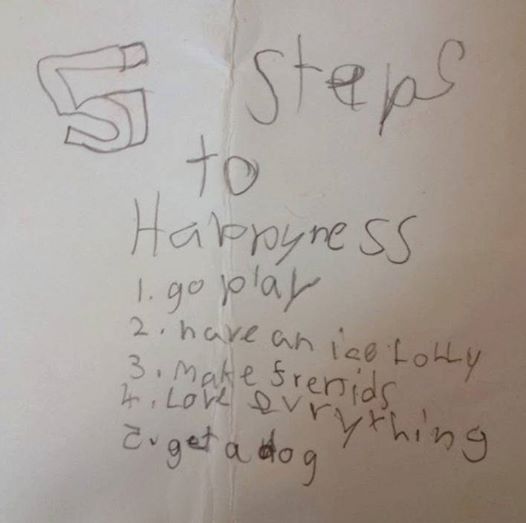
- Go play
- Have an ice lolly
- Make friends
- Love everything
- Get a dog
Sage advice.
15/04/2016
Elevator pitch
When I started this blog I had to write my 'elevator pitch'. How do I sell myself? I don't think I sold myself particularly well.
I've returned to this exercise several times and have never been satisfied with the result. It always sound a bit like a resume. Not exactly inspiring.
Out of all of the attempts, the following is the only part which I think comes close to satisfying the exercise.
I'm always finding ways to streamline the workflow process, finding new ways to save time and work smarter. I bring enthusiasm and intelligence to all the work I do, which means not only do I produce quality work, but I produce it efficiently. I'm very proactive, a lateral thinker and a keen learner.
It still sounds like the closing lines of a job application.
19/03/2016
It's all about the people
Continuing on from the last couple of posts which talked about how important the consideration of people are to a business, both in terms of internal working and dealing with clients/customers.
Some months ago I was speaking with a recruiter and he said that out of all the positions that their companies deals with it is the client service positions, the people who deal with people, that were most in demand.
Despite what most people think, dealing with people is one of the hardest skills. Probably because everyone has some people skills to some extent, whereas not everyone has technological skills, people tend to assume that dealing with technology is more difficult. Whereas technology can be learnt, but many people can't (or don't want to) learn good people skills. Or maybe they just don't want to (or can't) employ these skills as their main job.
I'm currently in a short-term contract as an artworker. There are four main departments involved in the work that I do, and they sit on a spectrum of whether you have to be better with computers or people.
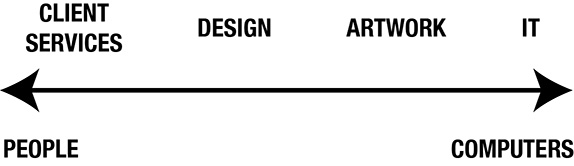
I have previously worked at all four of these jobs (not at the same time). Each department think they are better. Each department things they are most vital. Each department think that the other departments are vastly overrated.
While all departments could (in theory) be contracted out, it is client services that is most vital to the company. Any company. Client services are essentially the salespeople. Without them, there are no customers, and therefore no business.
In reality good people skills are needed for every position. It just makes everyone else's job that much more difficult if you have to deal with someone, no matter what department, who has bad people skills. It is probably why some people gravitate toward the Computers end of the above diagram. Just so they can get away from as much human contact.
Personally, I think the most difficult thing about client services, is not the colleagues down the other end of the spectrum, but the clients themselves. Just because someone has people skills doesn't mean the client does.