
13/10/2016
Thank you notes, conversation points and accountability
As part of LYL's Connect with Anyone course that I am currently doing, there are exercises that I have to complete.
Much of what I am learning about on this course is stuff that I already know. But there is a difference between stuff I already know, and stuff that I actually put into action.
Thank you notes
One example of this is the idea of a thank you note. Often when I have had a good meeting with someone, I will email them a thank you note. But it will probably be little more than just a thank you.
The exercise I had about thank you notes was to follow a set template, where the thank you note was more explicit and detailed. I suppose, previously I had always been worried about sounding insincere, despite knowing that people in client services do this sort of thing all the time.
So I chose my victim… sorry, recipient and sent her a thank you about a meeting we recently had. It was detailed and it was sincere. Part of the exercise was a suggestion to meet again. I made this suggestion and she wholeheartedly agreed. The thank you note worked very well.
Like I said, I think I knew all of this, but I was worried about seeming insincere. Having this exercise was like giving me permission to be open and explicit.
Conversation Points
Another exercise was about started conversations with complete strangers. Surprisingly, I don't have any problem with this (or very little problem), and the point in the exercise were points that I already abided by. Specifically, the three second rule. Once you've decided to talk to someone, do it within 3 seconds, otherwise you'll overthink it.
One of the useful points from this exercise was about subjects to talk about. I, unfortunately, often fall back onto the old standard of “what do you do?". But as this exercise points out, maybe someone's job is not the thing they want to talk about. It may be the least interesting, to them, thing to talk about. So this exercise gives a mnemonic of things to talk about: FISH – family and friends, interests, strengths and health & fitness.
I tried this with another new connection I had made. I asked him about his interests. And I got back an effusive response, included some interests that intersected with mine. From there we went on to have a lengthy and broad-ranging conversation. It really did work.
Accountability
As part of the Connect with Anyone course we have a weekly Skype call. At the end of the call this week, I was asked how the group could help me. I had achieved everything I wanted to from the last exercise, so I didn't know how to answer this. But shortly after the call, it came to me. The group is already helping, because they are keeping my accountable. I am actively doing all the exercises, otherwise I have to report back to them why I can't. This is something that Live Your Legend says that I need, an accountability buddy. For the next 8 weeks, I have one.
29/09/2016
Hans Rosling
Hans Rosling is a Swedish health statistician, whose company, Gapminder, invented a new way to visualise health statistics.
Like all good visualisation, it simplified the understanding of the information presented and the visualisation can be applied to other data. So much so that you can now use his graphing tools through Google graphs.
I came across Rosling on TED talks and he has done several of these. They are all very interesting to watch, and challenge many preconceptions through the visualisation of data.
He has also made two TV specials with the BBC. Here is a clip from one of them. What I like about his is that it combines his Gapminder graphs, his analysis of the data, his enthusiasm for presenting this data and combining of all of these through clever motion graphics and video editing. This is information visualisation at its finest, using all the possible tools to present 120,000 points of data in an engaging, understandable way.
29/09/2016
Kurzgesagt
Kurzgesagt is a German based YouTube channel which does really amazing animations, both in the visuals and the information they convey.
I'd really like to be able to work on videos like these. Here is an example of what they do.
22/09/2016
Introvert
I am an introvert.
Unfortunately this is a much misunderstood word. Introvert does not equal shy. An introvert is someone who draws their strength from within. As opposed to an extrovert who draws their strength from others. An introvert prefers solitude, but that does not mean they avoid crowds or people. It just mean that being within a crowd of people can be draining and an introvert needs alone time to recharge. An introvert often does their best work by themselves. It does not mean that they don't like people (although…). Human beings are naturally social creatures.
Many people do not believe that I am an introvert. I am gregarious. I am friendly. I can be outgoing. I appear confident. I hold my own in a noisy room. But I am more comfortable in one-to-one situations.
Last year I entered the Live Your Legend blog challenge. This blog that you are reading. And I won. At the time, I did not believe it. I thought this was just some marketing ruse, and that I had “won" just like everyone else had “won". But no, after talking with others at the Live Your Legend Local London event, I find out that others who had entered had not “won".
My prize for winning was entry to the “How to Connect with Anyone" course. This course starts next week, but this week there is a lot of preamble going on. One of the units that is available outside the main course is one called “Introverts 101".
This unit has several videos regarding introversion, most of them good. Although I think one of them equates shyness to introversion while all the others tell us that shyness and introversion are not the same thing. A bit of a mixed message from a unit that is trying to help introverts.
The “shy" video says that shy people can misinterpret facial expressions, or at least interpret neutral expressions as “I don't like you". Whereas extroverts interpret neutral facial expressions as “I like you". Although I personally think this is just the narcissism of extroverts where they think that everyone like them and they don't take a hint.
This is what the other videos suggest, that introverts are actually better at reading body language. They will notice when someone doesn't want to talk to them, or when they have been in a conversation for too long.
The thing is, I notice this all the time. Not a situation where I have bored someone to distraction, but more at networking events where I meet people and almost immediately they give off signals that they don't want to be doing this. While I respect that, it does annoy me slightly, as I think “why are you at a networking event if you don't want to talk to people?". The TED talk is this series of videos says that a third to half of all people are introverts. Possibly these uncomfortable people at the networking events are introverts just like me, and I should be more understanding.
Likewise, the video about “shy" people says they are prone to interpreting situations in a negative light. When remembering a social situation they focus on the negative. An extrovert will focus on the positive. Again, I could argue, this is the narcissism of the extrovert, not noticing anything other than how great they think they are. However, I do recognise that the misinterpretation by “shy" people could be the case. There is no reason to focus on the negative.
At the most recent Live Your Legend Local London event we did various exercises, many of which I had done a variation of before while following the LYL website. There was one that was a little different and that was to think about my weaknesses. I'd been asked to think about my strengths on many occasions.
The weaknesses I wrote were connection with people, calmness, forgiveness.
The first I believe is a result of my introversion. It's not that I can't connect with people. It's not that I don't continue those connections. But I feel that I am particularly choosy about the continuing connections. Maintaining connections takes work, or at least I assume it does. Or assume it comes easier to extroverts. Whereas I will just let connections fade because I sometimes find it draining to maintain them. The positives of a connection have to far outweigh the negatives for me to be the one that pursues re-connecting.
The second two, calmness and forgiveness, I believe it is part of me not focussing on the positive. If a situation annoys me, and I no longer remain calm (usually within) it is because I focus too much on the negative. And then I'm unable to reinterpret this same situation at a later date (forgiveness) because of this continuing negativity.
Then again, maybe I'm just beating myself up because I don't like some people, and I'm never going to get along with everyone. Maybe this is me misinterpreting a social situation. It was actually fine for everyone else, I just remember it in a negative light.
I would like to acknowledge that other people seem to not think this about me. As I said people think I'm gregarious, friendly, out-going, confident. And as I'm an introvert these situations can get draining. I just think that I could be better at these situation. I'm hoping this How to Connect with Anyone course will help.
21/04/2022
Re-reading this post in the future, I realise that Live Your Legend London suffered from an extrovert. I stopped going to the meetings because there was one person who dominated every meeting, pushing her own agenda, and not really caring (or noticing) what the rest of us wanted to do. I suppose the rest of us could have stood up and stopped her, but she was so relentless, all the time, from my point of view it was simpler to just stop going.
Having attended a Live Your Legend in Stuttgart, and had someone from Live Your Legend Madrid attend the London meeting, I know that these meetings are better than London's version.
08/09/2016
Habits and happiness
I'm currently reading a book on the science of habits, The Power of Habit by Charles Duhigg. One of the concepts it talk about is how habits form. It talks about the cycle: Cue – Routine – Reward. We do what we do because we are rewarded.
This extends to the workplace. If you do do work that you enjoy, it is because it gives you a sense of reward. Whether that been a feeling of satisfaction or the praise of your boss, client, whoever.
This made me think of the job that I left last year, and why I left it. I no longer enjoyed it. I had previously enjoyed it because I was learning new things, I got satisfaction from the projects that I created and I got praise from those around me. But in the last months of this job I was learning nothing, the completion of my work was interfered with, and if I did manage to successfully complete something, there was no praise, but that's because it probably wasn't that good due to the previous interference. It had become the opposite of enjoyable. So I left.
The most recent post on the Live Your Legend site dealt with how to stay a job, that you might not be enjoying, and find the positive to turn it around.
There were eight (or nine) points
1. Get interested in your colleagues
Possibly I didn't do this as much as I should have, but I have also realised since I left this job that the most creative people in the business were generally kept away from the creative decisions. And odd choice for a creative agency. I did become interested in the creative people (not in a creative position).
2. Become interesting and share what matters to you
This is the flip side. But this also needs that people want to be interested, have the imagination to be interested. However I did share with those who were interested.
But generally I think I was mocked for sharing. Anything not mainstream and suburban didn't really fit the vibe of a lot of people there. (See my previous post on scaffolding)
3. Find out your boss's pain points
I did this a lot, with both my immediate boss and the Managing Director, and I think I helped them solve a lot of the problems. The problem with this is that the other Partner, and at one point the then Client Services Director, did not see that these points needed to be fixed. They worked actively to keep things as they were. To berate me for wasting my time. To mock me if I achieved something (even though virtually everyone else at the company thanked me for it). And in the final months to actively stop me doing anything out of the ordinary.
I think what I'm trying to get across here is though the LYL post says there are ways of dealing with a bad job, my particular bad job had key members that fought as hard as they could to stop any change in the culture.
4. Discover the intersection between adding value and your interests
I actually did this. And manage to carve out a nice niche for myself. Until, again, I felt that this niche was got rid of (whether deliberately or not), thereby removing the thing I enjoyed most about the job.
5. Don't get sucked into negativity
Again, very difficult. In the end I actually refused to go into meetings with a certain member of staff because I didn't see the point. Nothing got achieved when he was in meetings. This was really near the end and I think this was the point when I thought “I have to leave"
6. Dress for success
In other words get noticed. And I got noticed. But that was a good and a bad thing. One partner loved my work. The other seemed to resent it.
7. Develop yourself outside of work
I definitely did this, and I continue to do so. In recent years I have gone to 6 TEDx events, travelled many countries, followed the LYL program, attended courses in Spanish, Javascript and Illustration, learnt new software, joined many MeetUps and started meditating.
8. Get outside your comfort zone
At this job I always took on tasks that I yet did not know how to do. I'm not sure this is 'outside my comfort zone', as I am comfortable doing this. I am comfortable learning new, unknown skills. I also was head of my department for about 50% of time I was at this job. Mainly because the various people in that position kept quitting (or was on holiday). This was definitely out of my comfort zone, and I think I managed it. But I doubt I could have done much more, as I think the culture of this company was to keep everyone within their defined box. They (or one of the partners) didn't really like innovation.
Always leave a party when you're still having fun…
I left way after I stopped enjoying this job. The problem was that I had enjoyed it, and I just felt there had been a shift in the politics at the top, where people were being made to pull their head in. Or more accurately, keep their heads below the parapet. It's very hard to do many of the above points in a company like that.
Since leaving this job I have been freelancing, irregularly. I have more been concentrating on what I want to do next. Especially by following the LYL program and other activities that it suggests.
Getting out of that job was definitely the right thing to do. But making a firm decision on my next move is something that I feel has alluded me. I certainly have many options before me, and indeed have been encouraged to just choose one and run with it.
But I haven't found that thing. That passion. Which I thought I might through all this exploration. (Although there are the naysayers who say “just do it, stop procrastination")
Some days I feel I've moved in the opposite direction of where I want to go. I feel demotivated.
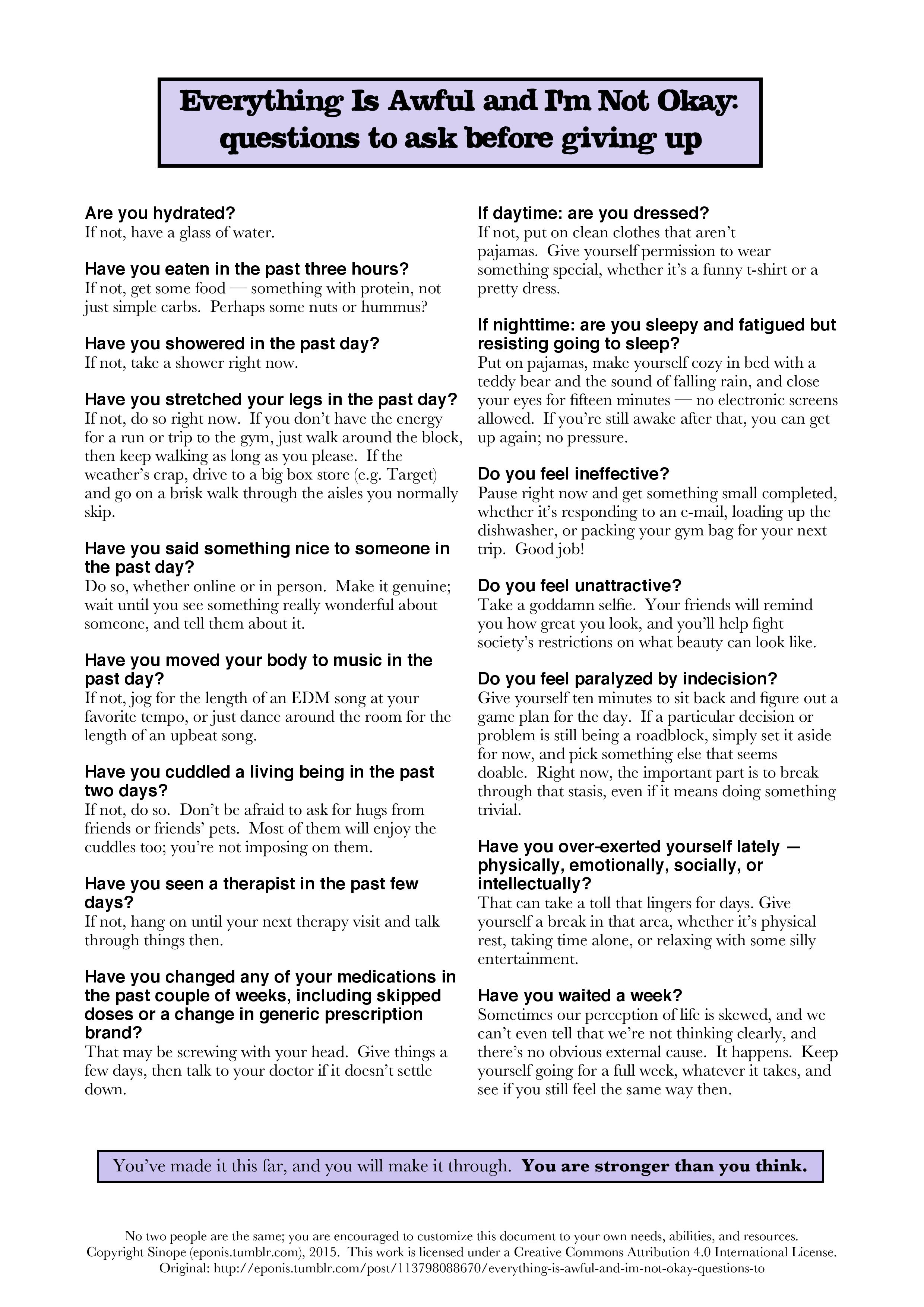
I recently found this list entitled “Everything is awful and I'm not okay: questions to ask before giving up"
I don't feel that “everything is awful", but I think some of the things on this list also help with demotivation. Especially as some days I stayed home all day, even if I am working.
14/07/2016
Stop searching and be happy
I have been following the advice on the Live Your Legend website for many months now, and I recently “completed" their 21 Days to Discover Your Passion course. I say “completed" as I think I failed on 3 of their steps and I still endeavour to complete these.
So did I find my passion? I don't think so. I don't feel passionate about the course to take in my life.
Recently I have watched three TED talks which are relevant to this. The first is by Terri Trespicio and is entitled Stop searching for your passion.
In this video Trespicio argues that, for some people looking for their passion is preventing them from living their life. If you don't know what your passion is, that doesn't matter. Go out and live life. Don't live your life through your passion. Discover your passion through living your life. Your can be passionate about many things. Or nothing. But don't worry yourself into indecision and inactivity because you think you haven't found that one thing. Anyway, that one thing might change.
My response to this is: I have been living my life and my passion has changed. I just wished, now, at this point, I had a clearer direction of where I should go. I suppose the answer from Trespicio and others is to just choose a direction and decide later.
Perhaps a quote about self-help from the talk show host Graham Norton is appropriate here: “The time you spent preparing yourself for the challenges of living are big chunks of life you will never get back".
Still, I don't feel like I'm wasting my time. Being in a job I disliked was wasting my time.
The second TED talk is from Nic Marks and is entitled The Happy Planet Index. In it the statistician talks about what makes us happy. Which countries seem to be doing it right (the answer is Latin America, specifically Costa Rica). And what makes us happy.
It is this last point I want to repeat here. He says that five positive actions can you do to improve well-being in your life, five things that you should do every day to be happier are these: Connect – your social relationships are the most important Be active Take notice – be mindful of yourself and your surroundings Keep learning – be curious Give
While following the Live Your Legend program I have definitely done more of all of these points. Connect – I have joined many Meetup groups and generally become more social. I've even spoken with family in Australia more. Be active – I have started doing exercise regularly. Take notice – this is something I think I've always done. But more recently I have started meditation. Keep learning – I needed no encouragement to do this. I do this all the time. Give – I have volunteered to help people, and I intend to do this more.
I find it interesting that these are also points that are emphasised by the Live Your Legend program. Possibly the way to find your passion is to do the things that make you happy. Not in an hedonistic way. But happier is a way that positively affects your mental health.
In a related TED talk, The surprising science of happiness, Dan Gilbert shows us that happiness come not from freedom (i.e. infinite choice), but from being present and enjoying our current situation. He shows that we have the capacity to manufacture our own happiness and that by giving ourselves too much choice our worries become more not less.
The lesson to be taken from all of this? Stop worrying, stop searching, live life, be a good person and you will be happy.