
11/03/2016
Further notes from Zero to One
Some further lesson to be learned from reading the book Zero to One: Notes on Startups, or How to Build the Future by Peter Thiel and Blake Masters.
Monopoly not competition
It is hugely more likely that a new business will succeed if it has a market all to itself, i.e. a monopoly. Competition means that's profitability is going to be low as prices will affected by the competition. It is harder to be notice if you a business is not unique.
Also any company that emphasises its uniqueness must have competition, while those that have a monopoly don't want to admit it (for fear of attracting the attention of the government) and so emphasise the 'fact' they have competition.
I contrast to this, a recent Live Your Legend post said Why Competition is Meaningless (and How Your 'Competitors' are Actually Your Best Teachers). Basically saying that you can always find your uniqueness.
Start small
If you have a new idea, that will take the world by storm, don't try to start with the world. Choose a small market, whether geographically or demographically or some other-ically. Then you'll know that it works, gain experience and get your momentum going to expand more.
Have a plan
Obviously really.
Executives manage, directors govern
You have to decide what you are going to be in the business. Ultimately if you are in charge then you are a director, and if you have executives to run the day to day then you should let them.
Have people that gel
Probably one of the most important things, and unfortunately one of the issues I had with my first business.
Sales
Again, as I said in the last post, this is something that I think was lacking in my business. Sales are all important otherwise there isn't a business, but sales is also about people. The salespeople and the customers.
Tech and man work together
Sort of a “work smarter, not harder". A good piece of tech, or well written piece of software, or amazing user experience will make your life easier, your business run better/faster/more efficient and/or it will sell your business. It could be the edge that the business needs. These days it's very important.
06/03/2016
Lessons Learnt
I have just finished the book Zero to One: Notes on Startups, or How to Build the Future. Not that I'm necessarily looking to form my own startup, but it's one of the ways I'm searching for inspiration.
The book is a very tightly written examination about what makes a good business, especially in today's tech world.
It got me thinking about the business that I started and ran many year ago, a magazine called The Core.
In the book it puts forward seven questions that must be asked about a business before it starts. I want to apply these (retrospectively) to The Core.
1. The Engineering Question.
Can you create breakthrough technology instead of incremental improvements?
I don't think this question is relevant to a magazine. However, I believe we created, and I believed that we would create, a large improvement for our target audience.
2. The Timing Question.
Is now the right time to start your particular business?
Yes, absolutely. I believe, and I believed, that we started the business at exactly the right time.
3. The Monopoly Question.
Are you starting with a big share of a small market?
Yes. The book spends a whole chapter defining the difference between monopoly and competition and how both are often obfuscated. While, technically, we had competitors and we were going into direct competition with them. In reality we were breaking into a new (small) market which no-one had seriously addressed.
4. The People Question.
Do you have the right team?
This is a big question. I will address this again after the rest of the questions.
5. The Distribution Question.
Do you have a way to not just create but deliver your product?
When talking about a magazine, distribution can mean how to get the physical product to the readership. While the magazine had a large distribution area, and possibly could have been done better, I don't think this is what this question is asking. In the case of the magazine, it's talking sales, i.e. selling advertising.
The book talks about how this is one of the hardest, underrated and (again) obfuscated jobs. The magazine did not sell it's advertising well. We didn't have a decent 'advertising manager', as we called the position. We had too different people in that position over the course of two years, Richard and Sue, and both bought their own skills to the job, but ultimately we needed a better person in that position.
Also, I needed to understand this role better, and to tell you the truth, I don't think until I read this book did I really understand the value of a 'salesman'. I put this word into quotes, and I said that this role was obfuscated, because (as the book says) often this role is hidden under different titles within companies. This is the role that is most people facing, and ultimately is probably most difficult.
I know from current experience and talking to recruitment agents in the corporate marketing arena, “client service" people, which again is just code for salesmen, are the most in need people, and also the roles that have the highest turn over.
It is difficult to find a good person for this role. I think at the time we didn't do so bad, but there was miles of room for improvement. This also lead me to the actual sales, which I will address after the numbered questions.
6. The Durability Question.
Will your market position be defensible 10 and 20 years into the future?
To tell you the truth, we never thought that far, and as technology was changing, we could not have know where we would have been. However we did think of the future and expansion. We just never got to that point.
7. The Secret Question.
Have you identified a unique opportunity that others don't see?
Yes.
We were at the right time with the right product and we quickly became a pivot point in the market we were aiming for.
Further Questions
Sales
The lesson learnt that I had previously written down was “Pay attention to the money. Have systems in place to ensure you get paid."
Pricing
he problem with our sales was that we didn't have a very good pricing structure in place. Although we had a rate card, the actual price charged was fairly random. Even then clients sometimes tried to pay what they wanted, not what we had billed.
Contracts
We should have, from the start, got our advertisers to sign up to payments. If they were going to get credit from us, then we should have made this more legal. Too often clients would delay payment, or even just not pay us.
Payment
For the non-payers we really should have pursued much more vigorously through legal channels. We had a real problem with the flow of money.
People
This, I believe, was the major contributing factor to the downfall of the business, or at least, the downfall so soon into its life (after two years).
When I started working on The Core, I had a business partner who was supposed to be in the background. Due to the workload, he soon came to work everyday on the business and it was obvious to all that he and I did not get along. It was our relationship that was the biggest problem at the magazine.
I think we both bought vital elements to the business, but ultimately it was my idea and I was the driving force. I spent at least 6 more hours daily working than he did.
Other notes I had made about Lesson Learnt were:
- Make sure that a potential business partner is someone you can work with.
- If someone has a role in the business, make sure they can do that role. Monitor it. And have a way of dealing with mistakes and failures.
- Put in structure for the management of the business. Fill the positions well.
- Take the hard decisions and stick to those decisions.
All of these are about my business partner. In the end it was he who was supposed to be managing the money and didn't. We went bust. Although I also admit culpability as I should have been paying attention to him.
My biggest lesson learnt?
People – get the right people (partners).
My next biggest lesson?
Sales – which is ultimately about people (customers).
28/02/2016
What stopped me?
This blog and the Live Your Legend course is supposed to help me look forward. But also it involves some self-reflection and looking back. Sometimes at the negative things.
LYL often asks "What's stopping me?", but I want to explore “What stopped me". Why, at specific times in my life, did I not move forward? And the times I did.
I made a table detailing what I did in each year, and initially I was going to post that table. But decided that the whole thing was too long.
Reviewing what I had written I realised that there were many years where I was moving forward.
My first moving forward period involved:
- Leaving home and finding my own employment.
- Being unemployed for two years, but spending that time by learning a new skill.
- Starting my own business.
- After that business go bust, using the skills I had learned starting a career in artworking.
- Returning to university and actually completing a degree.
After completing my undergraduate degree, I returned to artworking, rather than using any new skills from my degree. Within a couple of years I realised that inertia had set in and I needed a change. I left Australia and went travelling.
After a few months settled in London. Initially I had to establish myself in London – in my personal life, in my accommodation and in my career – but I quickly settled into a routine. Although this included a lot of travelling, I feel that this was major period of inertia. I had moved to London, but I hadn't changed my life. From leaving university, this period lasted 10 years!
So I went back to university again for a Masters degree. Retrained. Used my new skills to get a good contract. Eventually got a full-time job.
I initially learned new stuff at this job and got a promotion. But the company really wasn't going anywhere. This then lead to another period of inertia. I should have left after a couple of years, but stayed four. So I would say that those last two years could have been better spent.
But I did leave and that brings me to now. The contract that I currently have is definitely not me moving forward. I recognise that is just a stop gap while there is some easy employment available.
However I feel that now I am moving in the right direction.
27/01/2016
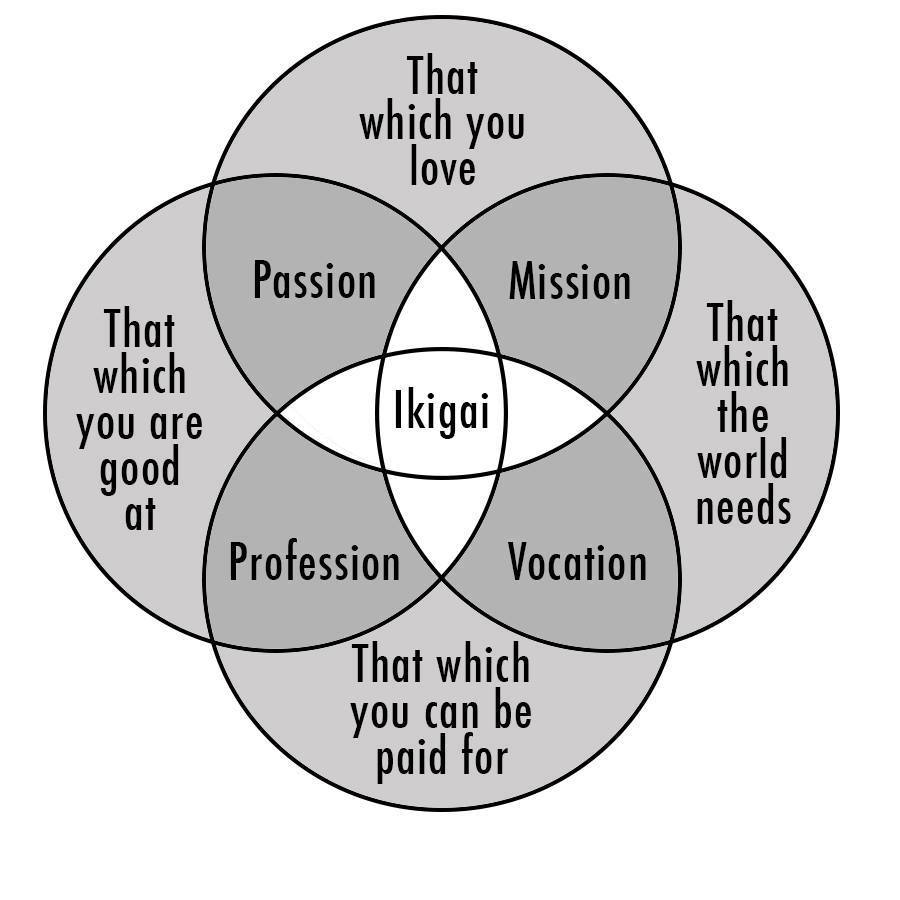
Ikigai
Ikigai (生き甲斐, pronounced [ikiɡai]) is a Japanese concept meaning “a reason for being". Everyone, according to the Japanese, has an ikigai. Finding it requires a deep and often lengthy search of self.
22/01/2016
What's my passion?
I started the Live Your Legend course as a career development activity, which is what it is intended as. But their philosophy is not what should your career be, but what do you really want to do (and can you make a career of it). What's your passion?
But to know this, you really have to know yourself. So, in a way, the course is also a self-development course. It encourages me to find out about myself, to know what I really want to do.
Part of this is writing this blog. It is a way of focussing my thoughts.
I'm not sure it's a 'passion' (maybe it is), but it's what I always end up doing. It has been define variously as "Making a difference", "Creating focus" or "Facilitator". I will explain by first giving examples.
My biggest working passion that I ever had was The Core magazine. I was in my early 20s and I started a magazine that covered the emerging dance music scene in my home town of Adelaide. These days it would be called “EDM". This passion has seemed effortless at the time. Not the work. The work was hard and demanding and consumed my entire life, my every waking moment. But getting into this passion, taking this path, knowing the path… all that was effortless. It seemed 100% obvious, to me, at the time, what course I should take.
I thought the reason I liked this so much because it was a design/publishing job that I really enjoyed, and that this was part of my passion. And maybe it is. But recently this job, along with others, have shown me that I have another passion.
I started The Core because I saw there was need for this market. Not in the sense that there was a gap in the market (there was), but I didn't see it as a gap that needed exploitation, but a gap that desperately needed to be filled. The dance scene needed a focus, needed a disseminator of information. And according to the feedback that I got, this is exactly what The Core did, and it strengthened the scene.
In this way I “made a difference", I “created a focus" and “facilitated" (made the process easier) the workings of the Adelaide dance music scene.
Indeed through various publishing work that I have done, be it for clubs at university or here in London, I see that the way that I can make a difference is to create a focus. Create a forum where information can be disseminated.
When I look at the job that I recently left, where I had about 5 different roles, I see that the work I was doing there was also along a similar line. There was no in-house publishing element, but a lot of what I was doing, which was outside my actual job definition, was making a difference. Making my colleagues' life better. Whether that was organising a messy situation, or streamlining a process, or stepping in and demonstrating a better way. And I left once I was stopped doing these things (and things just started getting more chaotic again).
So, if I could find a job that combined all of these things then maybe I would have found my passion.
10/01/2016
Geek MeetUp
As part of the Live Your Legend course I'm doing, it has many suggestions of things to do, especially to go out and meet an expanding sphere of people. One the suggestions is to go to TED conferences, which I have done. I've been to four now, and I've another coming up later this month.
Another suggestion was to join MeetUp groups. MeetUp is an international website, to create local groups with specific interests. I was already a member of a couple of MeetUps, although these had effectively died, so I hadn't been to any meetings through these recently. But in the last month I have joined eight new ones.
Yesterday, I actually went to my first MeetUp. It was one of the 'Geek' MeetUps that I had joined. Now, I had in my mind what a 'geek' is. A geek is someone into technology and science-y stuff, but not as far down the rabbit hole as a nerd. Geeks are now cool. Geeks are ruling the business world these days (Facebook, Google, Apple etc).
However, although this MeetUp was labelled 'Geeks', it was actually full of nerds. Way further down the rabbit hole than advertised. Not that I found anything wrong with this. A more accepting, friendly group of people you are not likely to find. But nerds are somewhat socially awkward. And somewhat less successful than geeks. But it did remind me of 'the Rubble', which I will now explain.
I have done three degrees (Maths Science, Communication Studies, Digital Media) at three different universities. The first of these was at the University of Adelaide and I was still a teenager. At this uni I joined many clubs. The Clubs & Societies Association had club rooms. These had the nickname 'The Rubble' by those who used them. And this is where I ended up hanging around most of the time.
The university had lots of prestigious clubs, like ones for law students or medical student. They were exclusive. The Rubble was inclusive. 'The Rubble Rabble' as we called ourselves consisted of what I called the 'none of the aboves'.
These fell into two categories. It was full of people who either were shunned (for reasons logistical or social) from these clubs (generally quite nerdy people). But it was also full of people who hated the clique-iness of these exclusive clubs. They were above this kind of exclusionism. They hated exclusiveness. These people were quite often very cool, fashionable, intelligent, socially sorted. And so the nerds and the very cool mixed very easily and formed The Rubble. And from here is where I formed many of my greatest friendships.
So although yesterday's MeetUp wasn't exactly what was advertised (imho), I think I might return. Although I could pigeonhole a lot of these people, that would be unfair, as I know from experience that groups like these contain some very remarkable people.
17/12/2015
Strengths Finder
Yesterday I took the StrengthsFinder 2.0 test that is run by Gallup. I have been mulling over the results, and I will continue to do so. But here are my initial results and some of the highlights of the resulting report.
My top five themes are: Strategic, Learner, Achiever, Ideation and Intellection.
The definition of each of these given my Gallup is:
Strategic – creates alternative ways to proceed. Quickly spots the relevant patterns and issues.
Learner – has a great desire to learn and want to continuously improve. The process of learning, rather than the outcome, excites.
Achiever – has a great deal of stamina and works hard. Takes great satisfaction from being busy and productive.
Ideation – fascinated by ideas. Finds connections between seemingly disparate phenomena.
Intellection – characterised by intellectual activity. Introspective and appreciate intellectual discussions.
As part of the report, it offers “insights" into each of these themes and then asks questions to get me to consider these insights. Basically what do I think the top insights are, and from these what are the top top insights. So here are my top top insights…
Strategic
- generate innovative ideas
- generate ideas quickly
- have a knack for identifying problems
- solving them
Learner
- have little effort giving intense effort
- consistently produce topnotch results
Achiever
- complete work on schedule
- yearn to produce tangible results each day
- persevere on assignments until you finish them
- work as industriously on big projects as you do on everyday chores
- seemingly endless reserve of energy
Ideation
- think of new and different ways to do things
- brimming with ideas
- creative, imaginative
- original and innovative thinker
Intellection
- capacity for pulling information together
- very interested in solving problems
- accuracy
- cheerful, easygoing
27/11/2015
What's one thing I'm proud of?
Day four of the Seven Day Blog Challenge.
This one's an easy one. My magnum opus. The Core magazine.
When I was in my early 20s, I had left university without finishing my degree (I've since completed two). I had left my job at a pizza store. I had been unemployed for two years.
My time was spent learning this new desktop publishing thing. And going out on the new dance music scene (which recently was rebranded EDM). In my home town of Adelaide at the time there was one magazine that covered any sort of bar / club / music venue scene. And it was obsessed with rock. So it would take the advertising of the dance music clubs, but never cover the scene in their articles.
I got to know the movers and shakers on this scene and I kept harping on about how someone should do something about this. For months. Eventually someone got sick of me and retorted “Why don't you do something about it?" So I did.
I tried to get and failed to get a government startup grant. Instead I ended up borrowing money from friends. Using the computer and other kit from my (at the time) SO. We moved from the suburbs into the centre of town and lived in my office.
The magazine became my life. 14 hours a day, seven days a week. It was a weekly magazine, as soon as one issue was finished, we'd just start the new one.
Initially it was just me working on the mag full-time. Then after a few months my now ex-SO joined the team (uncomfortable to say the least). Another really good friend helped out a lot around the office, and eventually we got another paid office worker in (who became a really good friend and flatmate). We also had a pile of volunteers, writers, an in-house photographer, distributors and the entire dance music scene hanging around my office.
The magazine itself was very popular, and although it only ran for 2 years in it's original format, it now has it's own Facebook page and still has many people who remember it fondly.
I have a saying about those days. They were the best of time, they were the worst of times. I'm paraphrasing Charles Dickens here. But what I mean is that I had the time of my life and was living an heightened experience at the eye of newly emerging subculture. They were the worst of time because I was working with my ex and I was running a business with zero previous experience.
During those two years I made the best friends of my life. And it set me up for a career in graphic design.
My regret is that I haven't topped it since. I'm still looking for that thing that I am as passionate about as The Core.
26/11/2015
What do people thank me for?
Day three of the Seven Day Blog Challenge.
They thank me for thinking laterally and being reliable. I'll explain.
Thinking laterally
I often find solutions to problems that might not be obvious. The solution might not be obvious, but the problem might not be obvious too. People say “oh, we've always done it that way, it's not actually a problem", then I make a small suggestion and after a while they say "I can't imagine doing it any other way now".
This happens both at work and with friends. Intelligent solutions.
Being reliable
This is both with friends and at work, but I think (to me) it's more obvious at work. If someone really needs a job done, the job done now, the job done quickly, the job done accurately, the job done skillfully, the job done intelligently and the job done completely, I am their go-to guy. I know that at a particular company where I have frequently freelanced, there is a scramble among teams to get me on their team.
But friends have also thanked me for being reliable. I think sometimes they are surprised that I am. With friends I can appear somewhat carefree and definitely have a 'done give a damned' attitude about life. So when the time comes when they absolutely need me to be reliable, and I always am, they are surprised. It had never occurred to them to rely on me before. And they thank me.
25/11/2015
What makes me angry?
Day two of the Seven Day Blog Challenge.
Lots of things annoy me, but the thing that gets me really angry is stupidity. A willingness to be uneducated, to not learn, to hold on to a point of view in the face of logic.
This can be from small things like the disorganised commuter who is angry with everybody else for getting in her way, and then not realising that everybody else is processing through the various stages of commuting more quickly than her. But in her mind it's everybody else's behaviour that's the problem not her.
Or bigger movements, such as the one in Australia to 'reclaim the nation'. As the counter argument currently goes 'descendants of people who stole land and destroyed a culture, protesting against a non-existent invasion to take back a lifestyle they haven't lost.'
Having now written those two paragraphs I realise it is about people who have no self-awareness. Although one of the problems of accusing people of having no self-awareness is that you have to be sure that you yourself are self-aware.
Of course, there are even bigger examples of deliberate ignorance. People who use their culture or their religion, to steadfastly remain ignorant. They won't allow education of their people, or even if education is allowed then it is ignored or dismissed because it doesn't fix in with their ideology. I'm not saying that people shouldn't defend their own ideology, but when that ideology brings you repression and suffering, why defend it?
Strangely enough, as a child, I always questioned my own stupidity. I always felt that I was never smart. Even when the evidence was to the contrary, i.e. top of almost every class. I think it wasn't until my mid 20s that I thought that maybe I wasn't stupid.
Now, possibly I have the opposite problem. I don't think I know everything, but I like to try to find out about many things as much as possible. I am often better informed, especially about relatively obscure subjects, than those around me. I make an effort to learn about many different topics.
But then it can make me angry that when I do have the relevant facts, and I present them, they are ignored by someone simply so they can continue on in their mindset. They don't want to change their mind, so they are not going to listen to anything that will.
Ignorance makes me really angry.